I'll start off with the infamous analogy of public health:
A doctor is at a river bank. He notices a body floating down the river. He dives in, pulls the body out, does CPR, and saves the person's life. Soon as he is finished, another body floats down. So he jumps in again, repeats CPR, and saves another life. His friend, the public health epidemiologist walks up and sees the doctor. A third body floats down the river. The public health epidemiologist starts to walk off and the doctor says, "where are you going?" The epidemiologist replies "I am going upriver to see how these bodies are getting in the river."
Doctors have very important jobs. People get sick and they need somebody to help them. But a far smarter approach is to prevent the sickness in the first place. Sometimes this is works out great. Rather than treating millions of kids from getting measles, you can develop a vaccine so that no kids get measles. But when obesity is causing arthritis, heart attacks, diabetes, strokes, etc. getting rid of obesity is easier said than done.
So here I am, at the public health center of the country at the CDC. I've been here long enough to get a taste of what it's like. I am sure 1 year is a lot longer than 6 weeks, but here are some thoughts so far.
It is so much more relaxing. I know of lots of doctors who ended up staying in public health because they didn't want to take call and avoid the stress. It is way less stressful so far. I have a 40 hour work week that I get to pick. I can work at home if I want. Last week I worked from 6:30am-3pm. (I was giving a high school boy a ride to seminary. His family is from Congo, his dad works graveyard shift, and our church has a class that starts at 6am from 9th-12th grade).
I get to see Keiko so much more than during medical school. It's definitely nice.
Doing projects where we use computer programming to analyze data is definitely something I am more of a natural at than memorizing. Medical school is all about memorizing lots and lots of facts and being able to put them together. I now depend on logic to solve problems. I definitely feel more of a natural at it and this has been reinforced by comments from my supervisors.
But you do feel a little distant after spending time in a hospital. I am mainly working with numbers and charts, rather than with people. I personally feel that you save far, far more lives through this kind of research than working in a hospital, but you don't meet the patient and their family so it's a little harder to feel the gratification.
So where does this leave me? If I absolutely love public health and working at the CDC I have a good plan:
-Finish at the CDC, finish 4th year at medical school, and apply to pediatrics.
-Do a pediatrics residency
-Possibly do a pediatric infectious disease fellowship
-Return to the CDC to work as an Epidemic Intelligence Service Officer, which is a 2-yr program that almost all the people who work here start by getting trained through this program.
If I think i might want to do public health, but want to do a residency first, I probably will stick with the same plan.
If I don't really want to do public health...
-I may switch to surgery. I am kind of thinking pediatrics vs surgery. I haven't met a surgeon at the CDC yet.
We shall see... we shall see...
Tuesday, October 6, 2009

Monday, October 5, 2009
My job at the CDC
I have been here a little bit now. I'm starting to know what I will be doing here the whole year. I have a few different activities.
1. Outbreak investigations
This is probably the most exciting part. I am on the tuberculosis team and when there is an outbreak of tuberculosis and they request the CDC's assistance, then I accompany the team. We try and find out who has the disease, how much it has spread, and get people started on treatment and look for ways to control for outbreaks in the future. These trips are usually in the US, but can be anywhere in the world. (Tuberculosis outbreaks happen in the US more than I thought, often in homeless shelters or prisons.)
I am actually leaving for 4 weeks to investigate an outbreak on some small islands in the middle of the Pacific, leaving in mid-Oct. Keiko will be visiting her family in Japan during that time.
2. Analytic Epidemiology
This means I analyze data to try and come up ways to solve public health problems. The most common thing I have seen is people look for risk factors for diseases. For example, the CDC found out that lacking folic acid was a risk factor for many types of birth defects (mostly dealing with the spine). Now folic acid is in many cereals and lots of foods and those birth defects have drastically dropped.
All tuberculosis cases have data reported to the CDC from the whole country. It's a lot of data. My job is to look at it and try and find ways to help improve tuberculosis prevention. I have a few projects going on right now.
Most of the actual work for this is using computer programming, which I get to use more of my engineering hat for which is a nice break from the straight memorizing of medical school.
3. Surveillance
These are projects where we collect data or monitor a disease. I will be doing a project of doing tuberculosis surveillance of islands in the Pacific.
4. Public health education
We have many classes and seminars to help us learn. It's kind of up to us what to take. I can take classes on Microsoft Excel or computer programming, etc. I can go to conferences to learn about tuberculosis. Unfortunately, the dates don't work out for almost all the conferences my supervisor had planned for me.
5. Publications and presentations
I am supposed to present and write about the research I do. I hopefully will be able to fly to a research conference in New Orleans this spring and present some research and get an article published in a medical journal. Maybe even more than one.
1. Outbreak investigations
This is probably the most exciting part. I am on the tuberculosis team and when there is an outbreak of tuberculosis and they request the CDC's assistance, then I accompany the team. We try and find out who has the disease, how much it has spread, and get people started on treatment and look for ways to control for outbreaks in the future. These trips are usually in the US, but can be anywhere in the world. (Tuberculosis outbreaks happen in the US more than I thought, often in homeless shelters or prisons.)
I am actually leaving for 4 weeks to investigate an outbreak on some small islands in the middle of the Pacific, leaving in mid-Oct. Keiko will be visiting her family in Japan during that time.
2. Analytic Epidemiology
This means I analyze data to try and come up ways to solve public health problems. The most common thing I have seen is people look for risk factors for diseases. For example, the CDC found out that lacking folic acid was a risk factor for many types of birth defects (mostly dealing with the spine). Now folic acid is in many cereals and lots of foods and those birth defects have drastically dropped.
All tuberculosis cases have data reported to the CDC from the whole country. It's a lot of data. My job is to look at it and try and find ways to help improve tuberculosis prevention. I have a few projects going on right now.
Most of the actual work for this is using computer programming, which I get to use more of my engineering hat for which is a nice break from the straight memorizing of medical school.
3. Surveillance
These are projects where we collect data or monitor a disease. I will be doing a project of doing tuberculosis surveillance of islands in the Pacific.
4. Public health education
We have many classes and seminars to help us learn. It's kind of up to us what to take. I can take classes on Microsoft Excel or computer programming, etc. I can go to conferences to learn about tuberculosis. Unfortunately, the dates don't work out for almost all the conferences my supervisor had planned for me.
5. Publications and presentations
I am supposed to present and write about the research I do. I hopefully will be able to fly to a research conference in New Orleans this spring and present some research and get an article published in a medical journal. Maybe even more than one.
Sunday, October 4, 2009
CDC museum and some CDC history
The CDC had a museum day recently. I decided to take Keiko to show her the only part of CDC that has any interest to see. It has many campuses. The one I am on is only office buildings with cubicles and offices, truly nothing interesting to see as far as I can tell. The original campus has some impressive buildings, a museum, and a bunch of things that are pretty cool to see but you need special permission to get into, like the emergency operations center or microbiology labs.

 This is the current logo for the dept of health and human services and the CDC. They have a few, but I was hoping this was the one they would have for clothes to sell but this wasn't it.
There was one item that used something similar: anyone want a CDC onesie?

Here are some pics of the main entrance.


They check your car for bombs by looking in the trunk, hood. I was a little surprised. We went to the museum and these were pics Keiko found interesting.
The CDC started out as a branch of service that was purely for the military. It was also originally purely for malaria control. It was costing a lot of money to the military as they had lots of malaria problems in their training camps. While most of these organizations were in DC, the CDC decided to form home base where the problem was the worst, the south. Emory Univ donated a bunch of land and the CDC has been in Atlanta ever since. It eventually branched out into other infectious disease and now does all public health problems, including obesity, asthma, and works in many other countries.

The first is of a poster of a public health message to soldiers to drink only clean water.
 This is a machine that was known as the iron lung. It was one of the first artificial breathing machines. It was very common when polio was a common disease and all the children who were paralyzed (including breathing muscles) had to be put on these until they died or regained control. FDR made this disease famous (that's why he was in a wheelchair).
The CDC has helped eliminate polio from most of the world. It remains in only a few countries where 100% vaccination has prevented it from being eliminated.
 All CDC entrances have security guards and airport style security places. Keiko can't get into many buildings because she isn't a US citizen. She can't even visit me at work.
 This kind of shows what I do on outbreaks for tuberculosis or HIV. We found people who have the disease, interview them to find people they might have given to or received from and then go to all those people to test them for the disease. Anyone who test positive gets interviewed and we branch out to find more people. You can then find out who has the disease and treat them. You can also find certain places like churches, bars, homes where disease like tuberculosis might be spreading.
 Keiko is out to save the day from a terrible ebola virus outbreak!!!
 We are making pals with mosquitos, a diplomatic way to control malaria.
 This poster explains how dangerous diseases are transported. There are a lot of layers.
 Keiko was interested in small pox. As you may know, it was a terrible disease for a long time. It was also the first disease to have a vaccine. A farmer and doctor noticed people who got cowpox from the cows on the farm never got small pox and figured it out from there.

Small pox still exists in labs and some are afraid that some countries or militant groups may want to use it as a weapon so the CDC still stocks vaccines and has to be prepared for it.
If anyone has a question about the CDC, feel free to ask.
Here is the emergency operations center. I got a tour of it. It looks like NASA's central command. This is where they manage emergencies, like swine fly or 9/11. It was rather impressive looking.


 This is the current logo for the dept of health and human services and the CDC. They have a few, but I was hoping this was the one they would have for clothes to sell but this wasn't it.
There was one item that used something similar: anyone want a CDC onesie?

Here are some pics of the main entrance.


They check your car for bombs by looking in the trunk, hood. I was a little surprised. We went to the museum and these were pics Keiko found interesting.
The CDC started out as a branch of service that was purely for the military. It was also originally purely for malaria control. It was costing a lot of money to the military as they had lots of malaria problems in their training camps. While most of these organizations were in DC, the CDC decided to form home base where the problem was the worst, the south. Emory Univ donated a bunch of land and the CDC has been in Atlanta ever since. It eventually branched out into other infectious disease and now does all public health problems, including obesity, asthma, and works in many other countries.

The first is of a poster of a public health message to soldiers to drink only clean water.
 This is a machine that was known as the iron lung. It was one of the first artificial breathing machines. It was very common when polio was a common disease and all the children who were paralyzed (including breathing muscles) had to be put on these until they died or regained control. FDR made this disease famous (that's why he was in a wheelchair).
The CDC has helped eliminate polio from most of the world. It remains in only a few countries where 100% vaccination has prevented it from being eliminated.
 All CDC entrances have security guards and airport style security places. Keiko can't get into many buildings because she isn't a US citizen. She can't even visit me at work.
 This kind of shows what I do on outbreaks for tuberculosis or HIV. We found people who have the disease, interview them to find people they might have given to or received from and then go to all those people to test them for the disease. Anyone who test positive gets interviewed and we branch out to find more people. You can then find out who has the disease and treat them. You can also find certain places like churches, bars, homes where disease like tuberculosis might be spreading.
 Keiko is out to save the day from a terrible ebola virus outbreak!!!
 We are making pals with mosquitos, a diplomatic way to control malaria.
 This poster explains how dangerous diseases are transported. There are a lot of layers.
 Keiko was interested in small pox. As you may know, it was a terrible disease for a long time. It was also the first disease to have a vaccine. A farmer and doctor noticed people who got cowpox from the cows on the farm never got small pox and figured it out from there.
Small pox still exists in labs and some are afraid that some countries or militant groups may want to use it as a weapon so the CDC still stocks vaccines and has to be prepared for it.
If anyone has a question about the CDC, feel free to ask.
Here is the emergency operations center. I got a tour of it. It looks like NASA's central command. This is where they manage emergencies, like swine fly or 9/11. It was rather impressive looking.


Sunday, September 27, 2009
Memories of Grandpa Timothy
My aunt is putting together a collection of memories. He's alive, by the way. Not to confuse you with the title. Anyways, here what I put together, a happy happy part of my childhood:
I'll do my best to recall some of my best memories.
As a child:
"Grandparents are there to spoil their grandchildren" represents the majority of my my memories with Grandpa Timothy.
I took many many trips either by myself or with my brothers and sister from Seattle to Portland. "Good 'ol Knowles" was what we always said as we drove up to Knowles St. where Grandpa lived. I had my favorite place to sleep: his couch in his basement. The couch was old and well-used so that it was squishy and soft that you just sank right down into it. In this room, there were 3 tv's: one for Super Nintendo, one for Sega Genesis, and one for cable television. There were a few traditions that I will never forget during my trips to Portland. I remember the most the times when I was able to go by myself and do these things just the 2 of us.
-Go to the grocery store and buy a box of cereal of my choice. My parents only let me eat 1 bowl of cereal per day. This would often force me to poor cereal into the bowl, crush it with all my weight so that I could poor more cereal on top of it and get as much cereal as possible into the bowl. At Grandpa's, I could eat to my heart's content, which usually meant at least 2 meals a day. And I got to pick whatever cereal I wanted, no matter how sweet or unhealthy, which usually meant Fruity Pebbles or Captain Crunch Berries. Especially if I was with my brother Chris, we would go through an entire box of cereal at one sitting, and the milk would disappear just as fast. Having that kind of freedom to choose whatever I wanted was so fun.
-There was also unlimited soda in the giant fridge in the garage, including all my favorites: grape, orange, strawberry.
-Often on the same trip we would stop at a Toys 'R' Us and buy any game that I wanted. This was easily one of the things I was most excited to do. I could pick one of the newest games out there no matter how expensive. And I was able to play as many video games as I wanted at my own sleep schedule. Truly a boy's dream.
-We would go out to the same restaurant every time. It was an old diner, and I would get a breakfast like waffles or french toast every time. We would play Kino every time. And I would get to keep the money. He would pick my birthday for numbers. I never made more than $5, but that was a lot to me.
-We went to this local pizza place. It had arcade games and Grandpa would give me loads of quarters to use. This place eventually closed. It was a sad day.
-He would definitely joke with me every time we passed Dancing Bare, the strip joint with a giant sign with a bear. It would make me laugh every time. "You want to go to Dancing Bare this time?" He would always joke about girls with me since I could remember, ask me if I had any girls that I liked etc. When I grew up, he didn't understand why I would like any girls who weren't tall and blonde until he met Keiko, my wife. Then he finally understood.
-Sitting out in his hot tub. Having a hot tub in your house was exciting enough, but I was able to use it at my will. Good times.
There were many more fun things that we did, but these were the must-do's every trip.
These are memories as a teenager/adult:
-Getting to buy a video game every time we visited....just kidding. But I still loved to play his video games and eat cereal when I visited.
-When I had some musical or other music event I was in, grandpa always wanted to watch the whole thing. He would always pay attention and give such great compliments. There weren't many people I would rather show my music stuff to than grandpa.
-I remember having the worst injury of my life. It was a giant hematoma or collection of blood that dried up in my leg. I was in junior high and my mom had some conference to go to so she dropped me off. I needed way more pain control because I was sweating from pain 24/7. I just had my grandparents to rely on. Luckily they were there for me every second. I remember how much I appreciated it to this day.
-Scrabble tournaments: i don't think I have ever won a game to this day, even when I get to use the dictionary. Grandpa even teamed up with my Japanese wife and beat me. The other game we played alot when lots of family gathered was PIT. Grandpa wasn't quite as skilled at this game as you could always tell when he had the bear or bull cards.
-I love listening to Grandpa's stories from his mission or other stories from his youth. He has led such an interesting life. The things he could do as a missionary are also so different than what is allowed now: it's fascinating.
-Thanksgiving on Grandpa's ping pong table. The largest family meals I can recall.
Keiko's best memory:
Kara was working on Disney cruise and has some amazing discount. Grandpa decided he wanted to go but there weren't too many people who could go. Keiko was one of them. So Keiko and Grandpa went on a cruise, just the 2 of them :). They had a great time: going to all-you-can-eat buffets, seeing the Carribean, touring various islands, watching Disney shows, playing ping pong.
He also has helped Keiko alot with her English. Keiko stayed in Seattle to learn English. It was often only the 2 of them at home. Grandpa used his expertise to help Keiko with hard sounds like L and R. Gorilla gorilla gorilla, squirrel squirrel squirrel. I love him. :)
Things I like about grandpa:
-The love he shows for us grandkids, whether through
-watching our musical events,
-buying us video games and cereal
-or just joking around with us and treating us like his friends and grandkids.
-His amazing personal history
-His patience
I'll do my best to recall some of my best memories.
As a child:
"Grandparents are there to spoil their grandchildren" represents the majority of my my memories with Grandpa Timothy.
I took many many trips either by myself or with my brothers and sister from Seattle to Portland. "Good 'ol Knowles" was what we always said as we drove up to Knowles St. where Grandpa lived. I had my favorite place to sleep: his couch in his basement. The couch was old and well-used so that it was squishy and soft that you just sank right down into it. In this room, there were 3 tv's: one for Super Nintendo, one for Sega Genesis, and one for cable television. There were a few traditions that I will never forget during my trips to Portland. I remember the most the times when I was able to go by myself and do these things just the 2 of us.
-Go to the grocery store and buy a box of cereal of my choice. My parents only let me eat 1 bowl of cereal per day. This would often force me to poor cereal into the bowl, crush it with all my weight so that I could poor more cereal on top of it and get as much cereal as possible into the bowl. At Grandpa's, I could eat to my heart's content, which usually meant at least 2 meals a day. And I got to pick whatever cereal I wanted, no matter how sweet or unhealthy, which usually meant Fruity Pebbles or Captain Crunch Berries. Especially if I was with my brother Chris, we would go through an entire box of cereal at one sitting, and the milk would disappear just as fast. Having that kind of freedom to choose whatever I wanted was so fun.
-There was also unlimited soda in the giant fridge in the garage, including all my favorites: grape, orange, strawberry.
-Often on the same trip we would stop at a Toys 'R' Us and buy any game that I wanted. This was easily one of the things I was most excited to do. I could pick one of the newest games out there no matter how expensive. And I was able to play as many video games as I wanted at my own sleep schedule. Truly a boy's dream.
-We would go out to the same restaurant every time. It was an old diner, and I would get a breakfast like waffles or french toast every time. We would play Kino every time. And I would get to keep the money. He would pick my birthday for numbers. I never made more than $5, but that was a lot to me.
-We went to this local pizza place. It had arcade games and Grandpa would give me loads of quarters to use. This place eventually closed. It was a sad day.
-He would definitely joke with me every time we passed Dancing Bare, the strip joint with a giant sign with a bear. It would make me laugh every time. "You want to go to Dancing Bare this time?" He would always joke about girls with me since I could remember, ask me if I had any girls that I liked etc. When I grew up, he didn't understand why I would like any girls who weren't tall and blonde until he met Keiko, my wife. Then he finally understood.
-Sitting out in his hot tub. Having a hot tub in your house was exciting enough, but I was able to use it at my will. Good times.
There were many more fun things that we did, but these were the must-do's every trip.
These are memories as a teenager/adult:
-Getting to buy a video game every time we visited....just kidding. But I still loved to play his video games and eat cereal when I visited.
-When I had some musical or other music event I was in, grandpa always wanted to watch the whole thing. He would always pay attention and give such great compliments. There weren't many people I would rather show my music stuff to than grandpa.
-I remember having the worst injury of my life. It was a giant hematoma or collection of blood that dried up in my leg. I was in junior high and my mom had some conference to go to so she dropped me off. I needed way more pain control because I was sweating from pain 24/7. I just had my grandparents to rely on. Luckily they were there for me every second. I remember how much I appreciated it to this day.
-Scrabble tournaments: i don't think I have ever won a game to this day, even when I get to use the dictionary. Grandpa even teamed up with my Japanese wife and beat me. The other game we played alot when lots of family gathered was PIT. Grandpa wasn't quite as skilled at this game as you could always tell when he had the bear or bull cards.
-I love listening to Grandpa's stories from his mission or other stories from his youth. He has led such an interesting life. The things he could do as a missionary are also so different than what is allowed now: it's fascinating.
-Thanksgiving on Grandpa's ping pong table. The largest family meals I can recall.
Keiko's best memory:
Kara was working on Disney cruise and has some amazing discount. Grandpa decided he wanted to go but there weren't too many people who could go. Keiko was one of them. So Keiko and Grandpa went on a cruise, just the 2 of them :). They had a great time: going to all-you-can-eat buffets, seeing the Carribean, touring various islands, watching Disney shows, playing ping pong.
He also has helped Keiko alot with her English. Keiko stayed in Seattle to learn English. It was often only the 2 of them at home. Grandpa used his expertise to help Keiko with hard sounds like L and R. Gorilla gorilla gorilla, squirrel squirrel squirrel. I love him. :)
Things I like about grandpa:
-The love he shows for us grandkids, whether through
-watching our musical events,
-buying us video games and cereal
-or just joking around with us and treating us like his friends and grandkids.
-His amazing personal history
-His patience
Friday, September 25, 2009
From the CDC: orientation
I guess I've been here long enough that I can talk a little bit about the CDC.
The first 2 weeks was an orientation. It was 8am-5pm. The mornings were mainly lectures. Some of them were a review of epidemiology, the methods of how we are going to do studies on various diseases. Some were on how outbreak investigations were done. Others were done by famous epidemiologists that told stories of how they discovered now well-known diseases (e.g. Legionnaire's Disease) or investigated swine flu when there was an outbreak in 1the 1970's. One speaker is advising president Obama on swine flu.
The afternoons were case studies, or we would would slowly be given real evidence step by step and work through problems. For example, we were given the actual evidence when physicians were first trying to prove that smoking caused lung cancer. These were always really fun, like you were the first people to see this data and make the discovery.
One of the best parts was getting to know the other fellows. I have definitely noticed that public health is generally full of people who are extremely nice. All the fellows have something in common and I’ve found it quite easy to make friends. There are 9 of us. We are from all over the country, every one a different medical school.
Just from hearing all the amazing stories and feeling "I'm at the CDC!" made me really excited about it all. If that feeling continues the whole year, there is a good chance I could end up here again.
The first 2 weeks was an orientation. It was 8am-5pm. The mornings were mainly lectures. Some of them were a review of epidemiology, the methods of how we are going to do studies on various diseases. Some were on how outbreak investigations were done. Others were done by famous epidemiologists that told stories of how they discovered now well-known diseases (e.g. Legionnaire's Disease) or investigated swine flu when there was an outbreak in 1the 1970's. One speaker is advising president Obama on swine flu.
The afternoons were case studies, or we would would slowly be given real evidence step by step and work through problems. For example, we were given the actual evidence when physicians were first trying to prove that smoking caused lung cancer. These were always really fun, like you were the first people to see this data and make the discovery.
One of the best parts was getting to know the other fellows. I have definitely noticed that public health is generally full of people who are extremely nice. All the fellows have something in common and I’ve found it quite easy to make friends. There are 9 of us. We are from all over the country, every one a different medical school.
Just from hearing all the amazing stories and feeling "I'm at the CDC!" made me really excited about it all. If that feeling continues the whole year, there is a good chance I could end up here again.
Tuesday, September 22, 2009
Biking in Atlanta
I always planned to bike here. I knew I would have more time than in medical school and I could really get in shape and save on gas if I biked.
I live about 5.5 miles from where I work. however, the first 2 weeks I went to a different building which was 8-9 miles away. And I had no car, so I got a rather intense introduction to biking in Atlanta.
Unfortunately, biking it Atlanta is a famous for how bad it is. That goes the same for pedestrians. The train here is very sparse and doesn't go many places. Most streets, including big ones, don't have sidewalks for most of the time, and bike lanes are quite sparse.
By pure chance, possibly the only street with a bike lane around happens to be one that goes almost right from my apartment to my work. It's truly amazing. However, there is a problem with bike lanes in Atlanta.

 atlanta.mybikelane.com
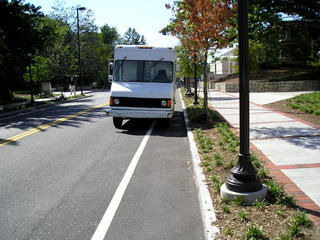
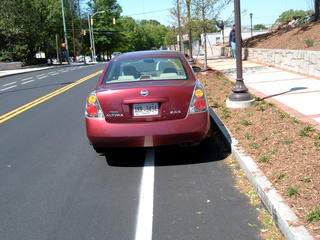
While cars ignoring bike lanes is a problem, my biggest problem is mainly bushes and trees growing into the bike lane, or the fact it seems to just disappear at times. Or people leave their garbage and recycling in the bike lane.
Forbes recently rated Atlanta #1 worst traffic in the country. This can't be helping.
I plan to stick with it whenever it doesn't rain. Which lately, has not been enough to keep me in shape. My brakes don't work in when they are wet, so I have little choice. I do have a nice helmet and lights both on the back and front of my bike, so don't worry mom. :)
I live about 5.5 miles from where I work. however, the first 2 weeks I went to a different building which was 8-9 miles away. And I had no car, so I got a rather intense introduction to biking in Atlanta.
Unfortunately, biking it Atlanta is a famous for how bad it is. That goes the same for pedestrians. The train here is very sparse and doesn't go many places. Most streets, including big ones, don't have sidewalks for most of the time, and bike lanes are quite sparse.
By pure chance, possibly the only street with a bike lane around happens to be one that goes almost right from my apartment to my work. It's truly amazing. However, there is a problem with bike lanes in Atlanta.
 atlanta.mybikelane.com
While cars ignoring bike lanes is a problem, my biggest problem is mainly bushes and trees growing into the bike lane, or the fact it seems to just disappear at times. Or people leave their garbage and recycling in the bike lane.
Forbes recently rated Atlanta #1 worst traffic in the country. This can't be helping.
I plan to stick with it whenever it doesn't rain. Which lately, has not been enough to keep me in shape. My brakes don't work in when they are wet, so I have little choice. I do have a nice helmet and lights both on the back and front of my bike, so don't worry mom. :)
Flooding in Atlanta
I've been trying to ride my bike to work most days. But I haven't rode once in 2 weeks. It has rained every single day...
I thought maybe this is how Atlanta is this time of year. But on my way to work yesterday, one of the major highways to work was covered in water. I made detour and got to work. I got an email at 3:30pm or so that we were all excused to go home that day and take the next day off. I turned to the news and learned several people had already died that day from flash floods, nearly all of them having their cars swept off the roads.
I decided to take their advice and headed home.
I tried to take my main route home: blocked by a tree that had fallen over and blocked the entire road.
My first detour: the whole road blocked by flooding. I went completely by guessing the general direction and eventually made it home.
My sidewalk in front of our apartment had at least 2 inches and with the forecast of more and more rain, I was getting to be pretty worried.
I also saw a home just a couple blocks from our apartment covered in rain, about the same as this pic:
 blogs.creativeloafing.com
There were at least 3 interstates that were completely covered and blocked. And many schools are closed for a while due to damages.
 This community isn't far from where we live:
 Some excellent pictures at: http://www.cnn.com/2009/US/weather/09/22/southeast.flooding/index.html?eref=rss_topstories#cnnSTCPhoto
We did, unfortunately, have someone in my CDC group whose home was hit pretty badly. I, for one, am a little more grateful for my apartment and safety.
I thought maybe this is how Atlanta is this time of year. But on my way to work yesterday, one of the major highways to work was covered in water. I made detour and got to work. I got an email at 3:30pm or so that we were all excused to go home that day and take the next day off. I turned to the news and learned several people had already died that day from flash floods, nearly all of them having their cars swept off the roads.
I decided to take their advice and headed home.
I tried to take my main route home: blocked by a tree that had fallen over and blocked the entire road.
My first detour: the whole road blocked by flooding. I went completely by guessing the general direction and eventually made it home.
My sidewalk in front of our apartment had at least 2 inches and with the forecast of more and more rain, I was getting to be pretty worried.
I also saw a home just a couple blocks from our apartment covered in rain, about the same as this pic:
 blogs.creativeloafing.com
There were at least 3 interstates that were completely covered and blocked. And many schools are closed for a while due to damages.
 This community isn't far from where we live:
 Some excellent pictures at: http://www.cnn.com/2009/US/weather/09/22/southeast.flooding/index.html?eref=rss_topstories#cnnSTCPhoto
We did, unfortunately, have someone in my CDC group whose home was hit pretty badly. I, for one, am a little more grateful for my apartment and safety.
Subscribe to:
Posts (Atom)